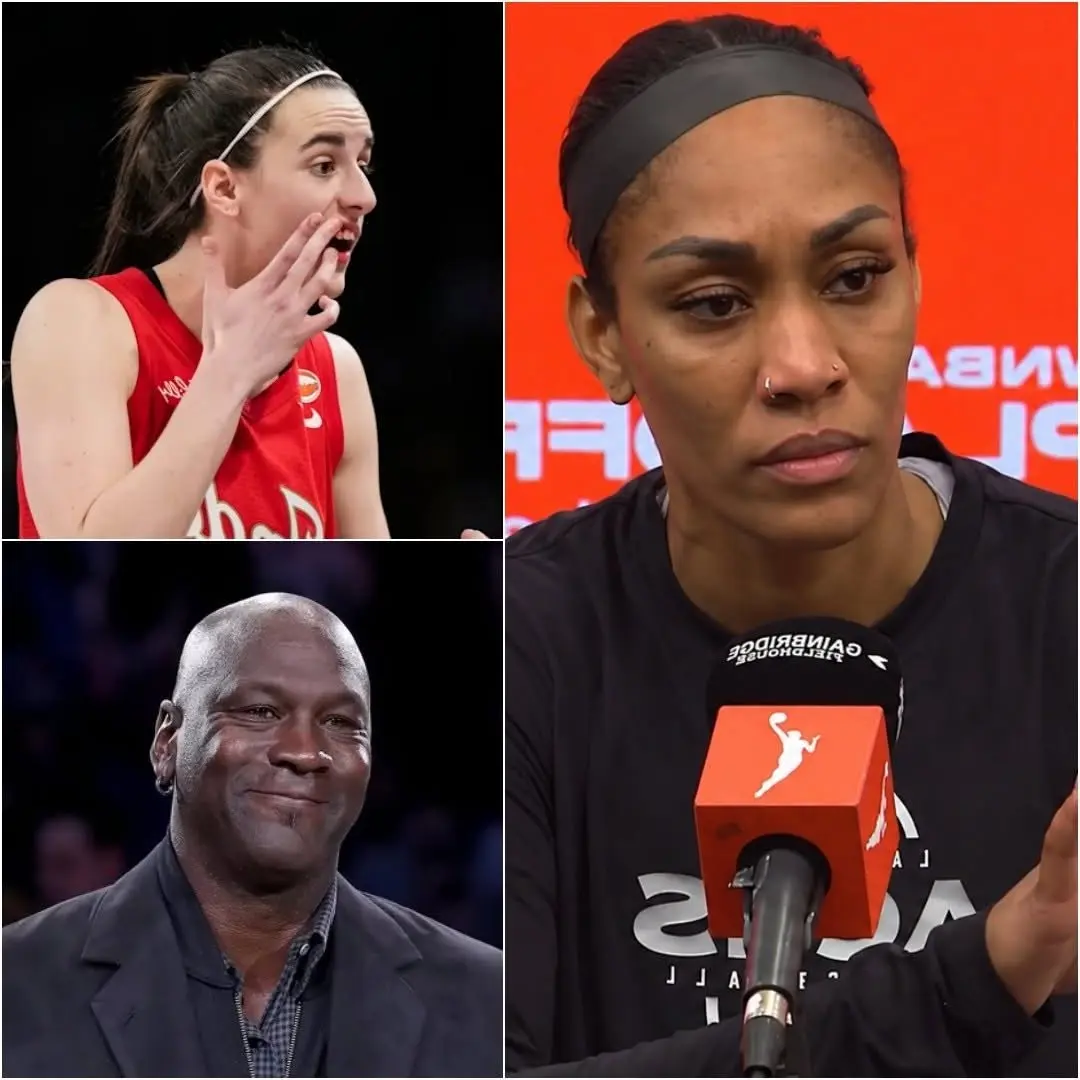

LAS VEGAS — Few rivalries in modern basketball generate as much attention as the competition surrounding A’ja Wilson and Caitlin Clark. One is an established WNBA superstar whose dominance has helped define an era. The other is a generational talent whose extraordinary shooting range, court vision, and popularity have brought enormous attention to women's basketball.
Now imagine a heated exchange between the two becoming the center of a nationwide controversy — only for NBA legend Michael Jordan to enter the conversation with a message nobody expected.
That is the premise of a dramatic story circulating around the words, “You lost, and you’re still talking!”
The viral narrative attributes a provocative statement to Wilson and claims that Jordan responded just 15 minutes later.
However, there is no verified evidence establishing that Wilson made the quoted remarks or that Jordan issued the alleged response. The following article explores the scenario as fictional sports drama rather than confirmed news.
At the center of the story is a question that has divided basketball fans for generations: Where does fierce competition end, and respect for an opponent begin?
THE MOMENT THAT IGNITES THE CONTROVERSY

A’ja Wilson is one of the WNBA's most accomplished and recognizable players.
In this dramatized scenario, the controversy begins after an intense game between the Las Vegas Aces and Indiana Fever.
The atmosphere is electric.
Every possession is contested.
Every whistle brings another reaction from the crowd.
And every physical exchange between the teams becomes a talking point among commentators and fans.
After the final buzzer, attention shifts from the scoreboard to a fictional postgame interview.
Wilson is asked about the physical nature of the matchup and the criticism surrounding contact against Clark.
In the imagined exchange, she responds sharply.
"That's sports — contact is unavoidable," Wilson says in the fictional scene. "Sure, that hit may have been a little on the light side, but she's my junior from Team USA, so believe me, we already went easier on her than we could have."
The remark immediately creates tension.
Some fans interpret it as an example of a veteran refusing to apologize for aggressive basketball.
Others see it as an unnecessary dismissal of a younger opponent.
Then comes an even more provocative line.
"You lost, and you're still talking!"
In the fictional storyline, the comment spreads rapidly across social media, generating thousands of reactions.
But the biggest surprise is still to come.
CAITLIN CLARK FINDS HERSELF AT THE CENTER OF ANOTHER DEBATE

Caitlin Clark's competitive performances have attracted substantial attention to the WNBA.
Clark has become one of the most discussed athletes in American sports.
Her remarkable college basketball career at Iowa helped introduce millions of viewers to her exceptional shooting ability and playmaking.
Her transition to the WNBA brought intense expectations, significant media coverage, and considerable debate about the league's growing popularity.
With that attention has come scrutiny.
Every performance is analyzed.
Every physical foul becomes a discussion.
And every disagreement involving Clark can quickly expand into a larger argument about officiating, competition, and sportsmanship.
In this imagined controversy, Clark initially chooses not to respond to Wilson's remarks.
Instead, she remains focused on basketball.
That silence only intensifies the speculation.
Fans begin asking whether she should defend herself publicly.
Some argue that professional athletes must accept physical competition without complaint.
Others insist that toughness should never be used to justify unnecessary contact.
As the debate grows, a familiar name unexpectedly enters the conversation.
Michael Jordan.
FIFTEEN MINUTES LATER: THE IMAGINED MICHAEL JORDAN RESPONSE

Michael Jordan's legacy is closely associated with fierce competition, resilience, and championship success.
In the fictional narrative, Jordan is informed about the growing controversy.
The six-time NBA champion understands the intensity of elite competition better than almost anyone.
Throughout his career with the Chicago Bulls, Jordan faced physical defenses, relentless pressure, and opponents determined to prevent him from reaching the basket.
His response to those challenges became a defining part of his legacy.
But in this imagined situation, Jordan does not criticize Wilson's basketball ability.
Nor does he suggest that Clark should receive special treatment.
Instead, he delivers a message about the responsibilities that accompany greatness.
"Great players don't need to remind people who lost. They show everyone what winning means."
The fictional statement immediately changes the tone of the conversation.
Jordan continues:
"If you're the best, prove it on the court. Respect the people chasing you, because one day they'll be the reason your legacy matters."
Within the dramatized story, the words resonate across the basketball community.
Fans who expected Jordan to choose a side instead encounter a message about leadership, humility, and respect.
The central issue is no longer simply who won the game.
It becomes a debate about how champions should treat their competitors.
WHY JORDAN'S MESSAGE WOULD CARRY SO MUCH WEIGHT
Michael Jordan remains one of basketball's most influential figures.
His six NBA championships, five regular-season MVP awards, and global cultural impact helped transform the sport.
His competitive mentality became legendary.
Jordan was never known for avoiding confrontation.
He embraced pressure, challenged teammates, and pursued victory with extraordinary determination.
That reputation makes the imagined response especially compelling.
A message about respect coming from an athlete famous for his relentless desire to win would carry a different meaning than the same statement from a neutral observer.
In the fictional scenario, Jordan is not arguing that basketball should become less competitive.
He is suggesting that competitive intensity and respect can coexist.
A player can challenge an opponent physically.
A player can celebrate victory.
And a player can speak confidently about personal accomplishments.
But greatness also involves recognizing the talent and determination of those standing on the opposite side of the court.
A’JA WILSON: A CHAMPION WHO HAS EARNED HER PLACE

Wilson has established herself among the leading players in professional women's basketball.
Any discussion involving Wilson should begin with recognition of her accomplishments.
She has been a dominant force in the WNBA, earning major individual honors and helping the Las Vegas Aces achieve championship success.
Her combination of scoring, rebounding, defensive instincts, and leadership has made her one of the defining players of her generation.
Wilson has also represented the United States internationally.
Her success reflects years of preparation, discipline, and competitive excellence.
In the fictional controversy, however, those achievements become part of a larger question.
Does being an established champion create additional responsibilities toward younger athletes?
Some supporters argue that veterans have earned the right to speak forcefully.
Others believe the most respected champions use their experience to elevate the entire sport.
The story imagines Wilson considering those competing expectations as public discussion intensifies.
But it is important to separate that dramatic interpretation from the real athlete.
There is no verified basis for claiming that Wilson made the inflammatory remarks presented in the viral post.
CLARK'S RISE AND THE PRESSURE OF BEING A GENERATIONAL TALENT

Clark's long-range shooting and playmaking have become defining elements of her game.
Clark's career illustrates another side of the conversation.
Young stars often arrive in professional sports carrying extraordinary expectations.
They are expected to perform immediately.
They must adapt to stronger opponents and more demanding schedules.
And they face criticism whenever their performances fall short of the attention surrounding them.
Clark's popularity has added another dimension to those pressures.
Her games attract passionate supporters, and her performances regularly generate extensive discussion.
That attention can benefit the league by introducing new audiences to women's basketball.
But it can also place other athletes under intense scrutiny.
Wilson and Clark represent different stages of professional excellence.
One has already established a championship legacy.
The other continues building her own.
In the fictional narrative, Jordan's message suggests that their differences should be celebrated rather than turned into personal hostility.
The sport benefits when established champions and emerging stars push each other toward greater achievements.
THE BASKETBALL WORLD DIVIDES OVER ONE QUESTION

As the imagined controversy unfolds, basketball fans divide into two broad camps.
One group argues that physicality is essential to professional basketball.
They point out that elite players must expect aggressive defense, difficult matchups, and occasional confrontations.
Another group emphasizes that physical competition should remain within the rules and that athletes deserve professional respect.
Both perspectives raise legitimate sporting questions.
Basketball is a contact sport.
Defenders are expected to challenge shots, fight for position, and contest rebounds.
But the rules also exist to distinguish legitimate competition from dangerous or unnecessary contact.
That distinction is especially important when public debate focuses on a particular player.
In the fictional storyline, Jordan's intervention redirects attention toward that balance.
He does not demand special protection for Clark.
He does not dismiss Wilson's achievements.
Instead, he emphasizes that competitive greatness should be demonstrated through performance and leadership.
AN UNEXPECTED SECOND MESSAGE
The dramatized story takes another emotional turn when Jordan offers a final reflection.
In this fictional exchange, he addresses both generations of players.
"To the veterans: remember that someone once gave you a chance to compete at this level."
Then he turns his attention toward emerging stars.
"And to the younger players: respect the champions who built the stage you're standing on. But never be afraid to earn your own place."
The message offers no easy winner.
Instead, it challenges everyone involved.
Veterans are encouraged to lead through example.
Younger players are reminded that respect must be earned through commitment and performance.
And fans are asked to appreciate the quality of competition without turning every rivalry into a personal conflict.
In the imagined scene, the conversation begins to change.
The original confrontation becomes less important than the broader lesson.
Basketball's future depends on both its established champions and the athletes preparing to succeed them.
WHY THE WNBA DOESN'T NEED A PERSONAL WAR TO THRIVE

The WNBA's growth has brought increased attention to its players, teams, and competitive storylines.
That attention creates opportunities.
More viewers can discover talented athletes.
More young people can find role models.
And more fans can appreciate the skill required to compete at the highest level.
But heightened visibility can also encourage exaggerated narratives.
A physical foul can become a supposed personal feud.
A brief remark can be interpreted without context.
And an unverified quotation can spread widely before anyone establishes whether it was actually spoken.
That is why accuracy matters.
Wilson and Clark are accomplished athletes whose performances deserve serious analysis.
Their competition is compelling without invented insults.
And Jordan's legacy is significant without attributing fictional statements to him as though they were real.
THE FINAL MESSAGE: GREATNESS IS MORE THAN WINNING
In the concluding moments of this fictional sports drama, Jordan's imagined words continue to resonate.
The scoreboard still matters.
Championships still matter.
Individual performances still matter.
But so do the standards athletes establish for those who follow them.
Wilson's achievements deserve recognition.
Clark's emergence deserves attention.
And Jordan's real legacy demonstrates the extraordinary heights that relentless competition can produce.
The story ends with one imagined message:
"Winning earns applause. Respect earns a legacy."
It is a fitting conclusion to a fictional controversy that began with confrontation and evolved into a reflection on sportsmanship.
Because basketball does not need its greatest stars to agree on everything.
It needs them to compete fiercely, respect the game, and inspire the next generation.
And sometimes, the most powerful lesson is not delivered by the final score.
It comes from remembering what makes a champion truly great.
DISCLAIMER: This article is a fictional dramatization inspired by an unverified viral claim. There is no verified evidence that A’ja Wilson made the quoted remarks about Caitlin Clark or that Michael Jordan responded 15 minutes later. All dialogue attributed to Wilson and Jordan within the imagined scenario is fictional and must not be presented as authentic quotations. The photographs are illustrative and do not document the alleged exchange.